Oct 15, 2026Buying Guides
Aluminum Electrolytic Capacitor Quality Claims: Evidence and Review
What to prepare when raising a capacitor quality claim: the information and test evidence that make a review possible, how failure modes are told apart, and how confirmed defects are resolved.
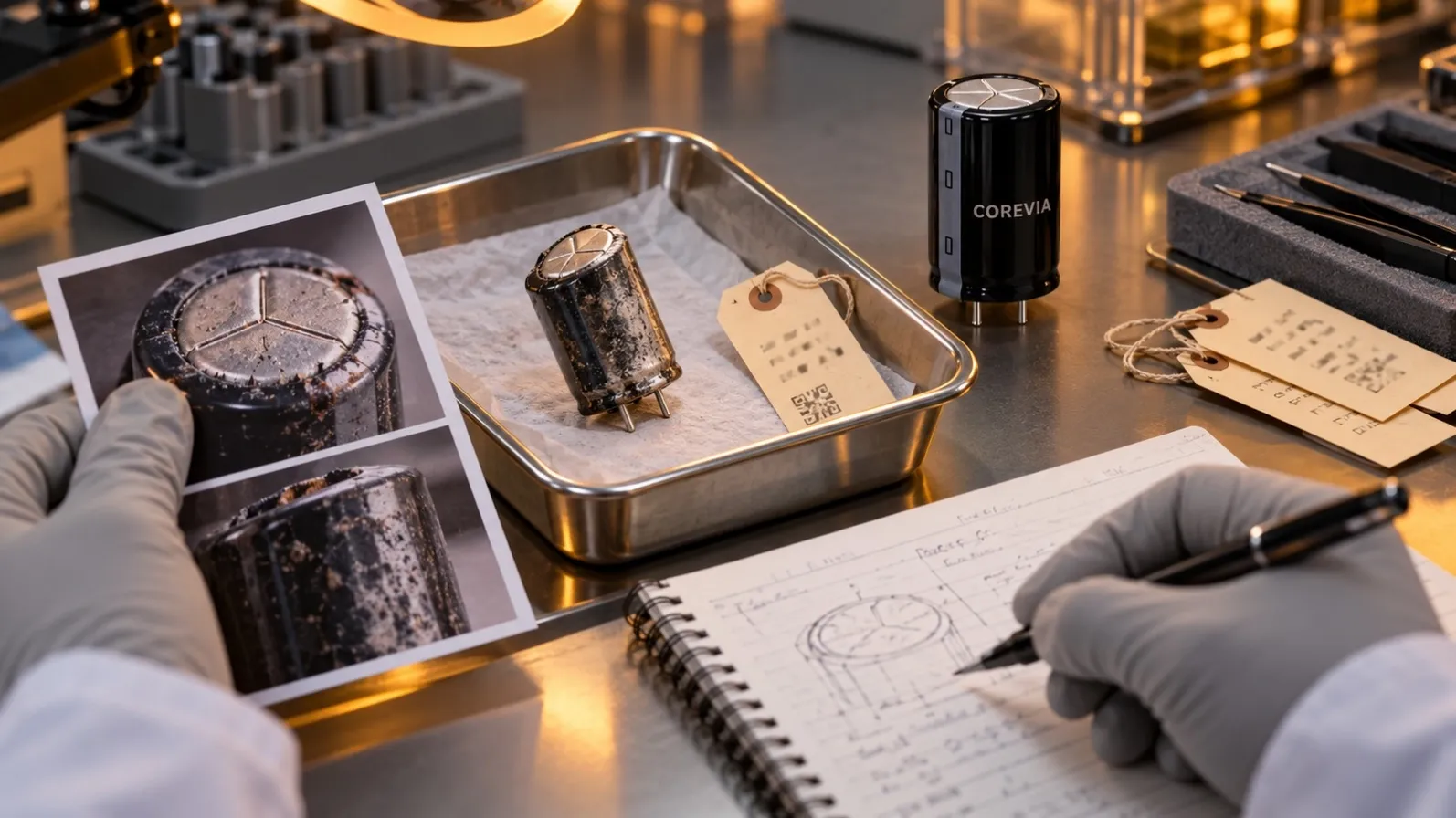
A quality claim is an engineering review with money attached — and like any review, its speed and outcome depend almost entirely on the quality of the evidence. This page explains what to prepare when a COREVIA capacitor fails in your incoming inspection or your application, how the failure review tells component, assembly and application problems apart, and exactly how confirmed defects are resolved.
First Actions When a Quality Issue Is Found
Three things, in order: quarantine the affected lot so nothing else touches production; record what was found — the parameter, the value, when and in which circuit; and keep the parts. Do not scrap failed capacitors, even photographically perfect ones. The physical parts carry the diagnosis: a vent that operated, a sleeve crack, a lead pulled from the seal each tell completely different stories, and the review needs the evidence, not the anecdote.
Part, Lot and Shipment Information to Preserve
- The part number and the specification revision the order was placed against.
- Lot and date codes from the parts and the shipping carton.
- Purchase order and shipment references, quantity affected versus quantity received.
- Storage and handling history since receipt — how long the parts sat, at what conditions, and what happened to them before the failure appeared.
Test Evidence and Application History Required
The measurements that flagged the problem, with their conditions: which instrument, what temperature, which method — measurement conditions are where review requests stall, and the readings-differences page explains why they matter so much. Photographs of the marked failed parts. And the application history: voltage actually applied, ripple current, ambient temperature inside your equipment, and how long the part ran before failing. Many reported "capacitor failures" are application stress wearing a component costume — a serious supplier will check that path, so the history saves everyone time.
Component, Assembly and Application Failure Review
The review's job is to place the failure honestly in one of three origins:
- Component — inside the capacitor: dielectric degradation, seal leak, vent operation from internal pressure.
- Assembly — caused by the process the part went through: reflow or wave damage, lead-forming stress, cleaning-agent attack. The failure patterns differ by family; see SMD reflow qualification and radial lead forming and assembly.
- Application — over-voltage, reversed polarity, overheating, ripple beyond rating, or a specification that never quite fit the circuit.
Sometimes the honest answer is "the specification didn't match the application" — not a defect on either side, but a mismatch to fix in the next revision. A review that can only ever blame the component is not a review.
Return Authorization and Review Steps
Before shipping anything back, ask what the supplier needs: typically a documented sample quantity from the affected lot — failed parts plus adjacent good ones — with the information above. The review runs against the specification revision pinned on the order, which is why that pinning (part of the purchase order checklist) matters long before any claim exists.
How Confirmed Defects Are Resolved
The COREVIA policy, stated plainly: when a quality issue is confirmed as a component defect, the defective quantity is replaced free of charge — one good piece for every confirmed defective piece — supplied with your next order. No claims-form gymnastics. What falls outside that: damage added by others in transit, assembly-process damage, and application misuse — those get the same engineering review, an honest finding, and a corrective recommendation, because the goal is that the failure does not repeat.
Quality Claim FAQ
How fast will we get an answer?
Honestly: the complete claims move fastest — lot codes, conditions and measurements let the review start the day the claim arrives, while incomplete ones wait on clarification. The commitment that matters is the resolution: confirmed defects are replaced one for one.
Do we have to return the whole lot?
No — a documented sample per the supplier's instruction is the normal route. The quarantine happens on your side; the physical review happens on the samples.
What if the review finds the failure was in our assembly?
Then that is the finding, delivered with the evidence and a recommendation for what to change — the assembly-side failure patterns are described in the reflow and lead-forming pages. An honest supplier tells you this; it is cheaper than the next failure.
Does the replacement cover the whole lot?
The confirmed defective quantity is the policy. If the review shows a systematic issue rather than isolated pieces, the scope is discussed on the findings — that conversation goes better with evidence than with estimates.
Can a claim be raised from incoming inspection findings alone?
Yes — a lot that fails agreed acceptance criteria enters the same review path described in incoming inspection and lot acceptance.
Have a failure to review? Send the part number, lot codes, the measurements with conditions and what the application was doing — we will confirm the review path and what to send.