Application Guides
Can You Pot a COREVIA Aluminum Electrolytic Capacitor in an Industrial Power Supply?
Can an industrial power supply encapsulate a COREVIA aluminum electrolytic capacitor? Review vent access, resin compatibility, cure heat, operating temperature and assembly evidence.
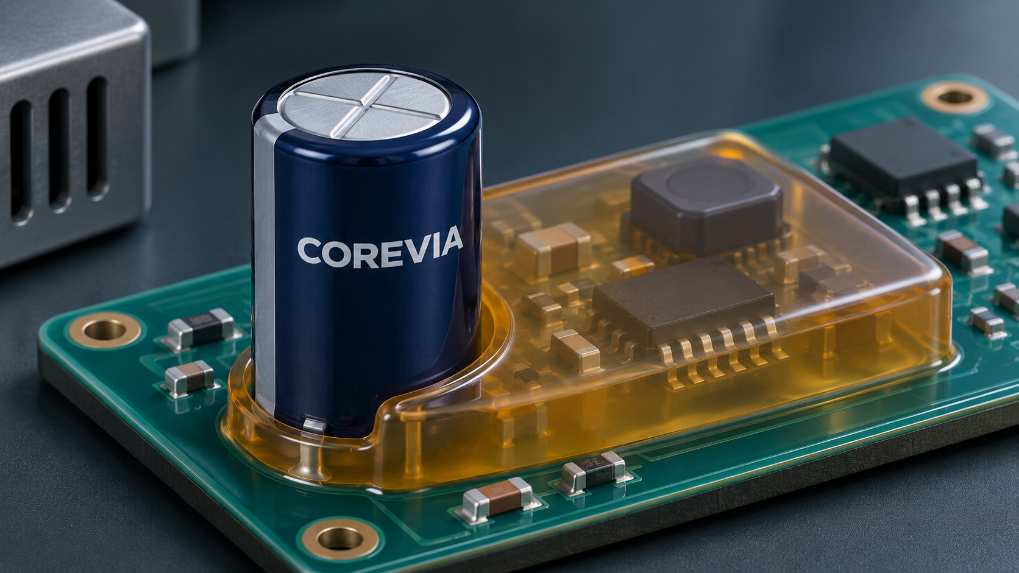
Do not fully encapsulate a COREVIA aluminum electrolytic capacitor in potting resin without approval for the exact part and assembly. Resin can obstruct a pressure-relief vent, change how heat leaves the can, introduce chemical exposure, and load the case as it cures or expands. In an industrial power supply, keep the capacitor outside the potted volume where the design allows. If partial potting or adhesive support is unavoidable, qualify the material, geometry, cure and operating temperature with COREVIA before production.
Why can potting change the capacitor's operating conditions?
An aluminum electrolytic capacitor is a sealed component with a specific vent and thermal path. A resin that flows over the top of a vent or across a seal can interfere with its intended function. A thick resin layer can also reduce heat transfer to surrounding air, so a case that passed a free-air test may run differently after encapsulation. Curing may temporarily raise component temperature; shrinkage, expansion and vibration can add mechanical stress after cure.
These are assembly-level effects, not a universal pass/fail property of resin. The result depends on the exact COREVIA capacitor family, resin chemistry, fill height, cure schedule, enclosure and electrical duty. A drawing showing only the resin boundary cannot replace a test under the intended load.
What should the design review record before approving partial potting?
Start with the full part number and its current drawing. Mark the vent, terminal and seal locations on an assembly cross-section. Record the proposed resin and adhesive identification, cure conditions, fill tolerance, nearby heat sources and how the capacitor is supported. Do not use the outer sleeve as an unverified structural attachment or as the sole electrical isolation barrier.
Review item | Question to answer | Evidence to retain |
|---|---|---|
Vent and seal | Can resin reach or obstruct either area at maximum fill? | Cross-section, fill tolerance and cured sample photo |
Material compatibility | Can the resin, cleaner or adhesive affect the sleeve, seal or metal? | Material declaration and part-specific review |
Cure exposure | What temperature does the capacitor actually reach during cure? | Measured temperature profile on a representative assembly |
Operating heat | How does potting change local air and case temperature under load? | Before-and-after temperature trends at defined duty |
Mechanical support | Can cured resin transmit stress to terminals or the can? | Mounting drawing and inspection after cure |
Keep the resin supplier's compatibility data separate from COREVIA product limits. A resin data sheet does not certify the capacitor assembly. Compare the measured temperatures and installation geometry with the exact capacitor-series requirements and the design's approved criteria.
How should a representative assembly be validated?
Build a sample using the production resin, dispense process, fixture, cure schedule and enclosure. Measure the capacitor's temperature during cure and after the power supply reaches its defined worst-case operating duty. Inspect for resin creep toward the vent or seal, sleeve changes, case deformation, and stress at leads or terminals. Capture photographs before fill, after cure and after the operating test, with the same orientation and scale.
If the design is revised, assess whether the prior approval still covers the new fill line, material, cure or capacitor position. A change in any of these can alter the original thermal or mechanical boundary. Send COREVIA the full part number, assembly drawing and measured conditions for a specific review; do not transfer a result from another capacitor series.
FAQ: potting around aluminum electrolytic capacitors
Can resin touch the lower part of the sleeve?
There is no blanket approval. The answer depends on the exact part, resin, fill height, seal clearance and operating conditions. Submit the proposed geometry and material for review before release.
Does a passing room-temperature functional test prove potting is safe?
No. It does not show the cure peak, sustained case temperature, vent freedom or long-term mechanical effects. Validate the actual cure and operating boundary.
Can adhesive alone hold a large capacitor in place?
Do not assume that the outer sleeve provides a qualified structural anchor. Check the exact part's mounting instructions and the assembly's mechanical loads before relying on adhesive support.
For a part-specific potting review, contact COREVIA with the capacitor part number, resin identification, cross-section, cure profile and operating temperature record.