Sep 24, 2026Reliability Engineering
New Capacitors, Still Tripping? Check the Pre-Charge Sequence
New DC-link capacitors, but the UPS, inverter or EV charger still trips? Learn how to check the pre-charge resistor, contactors, timing and connected loads.
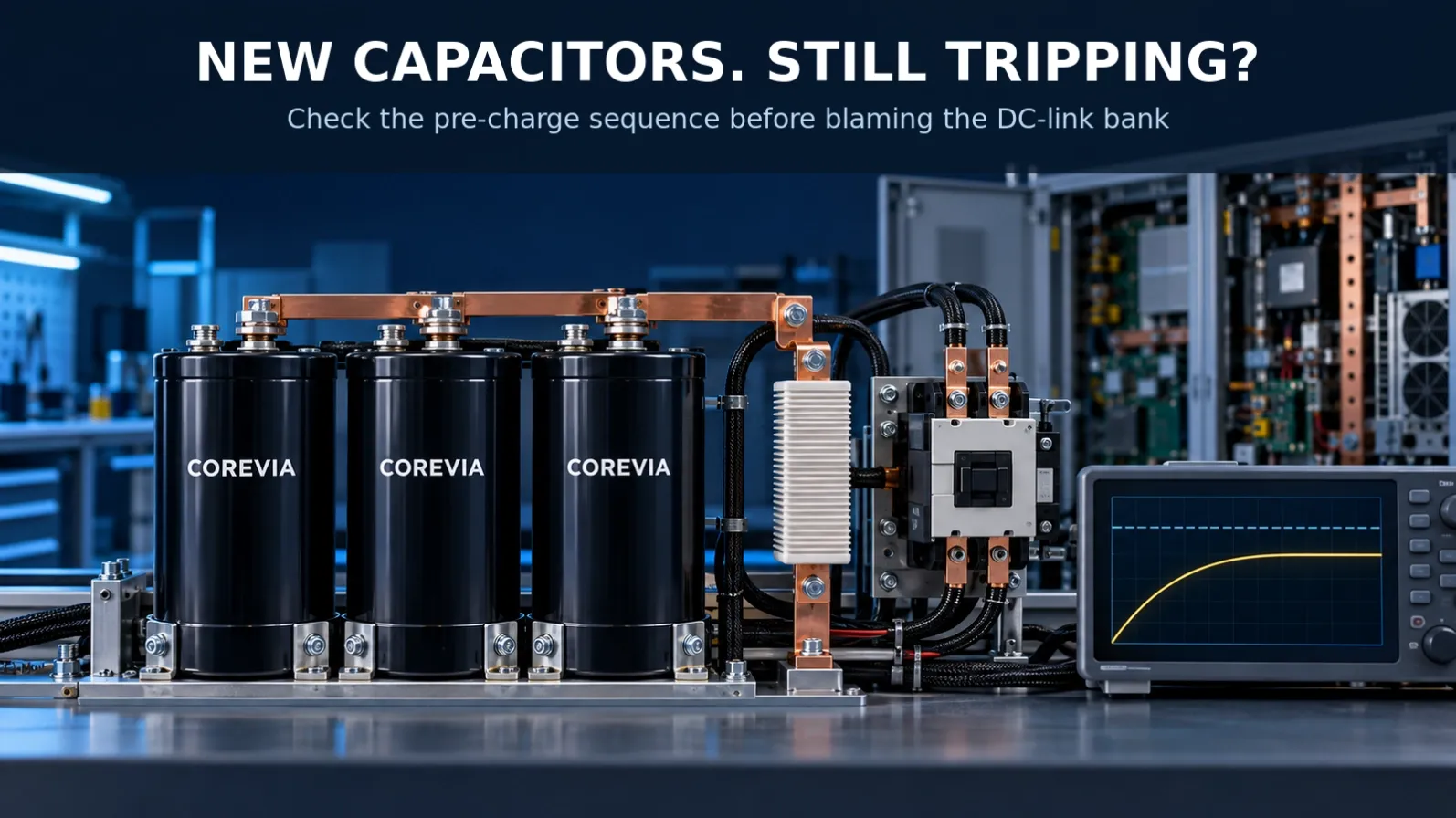
Replacing the DC-link capacitors should solve a capacitor problem. But what if the UPS, inverter, energy-storage converter or EV charger still trips during startup?
Do not assume the new capacitor bank is defective.
The fault may be in the pre-charge circuit—the part of the system that charges the DC bus gradually before the main contactor closes.
WHAT THE PRE-CHARGE CIRCUIT DOES
An uncharged capacitor bank initially behaves like a heavy electrical load. Connecting it directly to the power source can create a very large inrush current.
The pre-charge path limits that first current and allows the DC-bus voltage to rise in a controlled way. Once the voltage is close to its target, the main contactor closes and bypasses the pre-charge resistor.
If this sequence is too fast, too slow or incomplete, the equipment may trip even when the capacitors are healthy.
THREE STARTUP PATTERNS THAT TELL YOU WHERE TO LOOK
IMMEDIATE TRIP
Check whether the pre-charge resistor is being bypassed too early. Also inspect the contactor wiring, welded contacts, control logic and any maintenance changes made during the capacitor replacement.
SLOW DC-BUS VOLTAGE RISE
The resistor may have changed value, cracked or developed a poor connection. The replacement bank may also have more total capacitance than the original design, so the old timing may no longer be suitable.
Check whether another load is already connected to the DC bus during pre-charge. Fans, auxiliary converters or power modules that start too early can prevent the voltage from rising normally.
VOLTAGE STOPS BELOW THE TARGET
This often points to an active load, leakage path, wiring problem, weak input source or incorrect voltage measurement—not automatically a bad capacitor.
If the controller never sees the expected DC-bus voltage, it may keep the system in pre-charge mode until the resistor overheats or the startup timer expires.
WHY THE PROBLEM MAY APPEAR AFTER CAPACITOR REPLACEMENT
The new capacitor may fit physically and have the correct voltage rating, but the complete bank may not match the original design.
Check the total installed capacitance, the series and parallel arrangement, the pre-charge resistor and connections, both contactors, startup timing, connected loads, residual DC-bus voltage and all wiring restored during maintenance.
Changing the capacitor bank without checking the startup sequence can leave the real fault untouched.
WHAT TO RECORD DURING DIAGNOSIS
Capture the DC-bus voltage from the moment startup begins until the main contactor closes or the system trips.
Record the input voltage, bus rise time, contactor commands and feedback, resistor condition, complete bank configuration, fault code and exact trip time.
The shape and timing of the voltage rise are usually more useful than another room-temperature capacitance measurement.
PRACTICAL CONCLUSION
New capacitors do not guarantee a successful startup.
If the equipment still trips after capacitor replacement, treat the capacitor bank and the pre-charge circuit as one system. Check the resistor, contactors, wiring, voltage feedback, connected loads and control timing before replacing the capacitors again.
SAFETY NOTE
High-voltage DC equipment can retain dangerous energy after shutdown. Diagnosis and discharge procedures should be performed only by qualified personnel following the equipment safety instructions.
COREVIA
Aluminum Electrolytic Capacitor Solutions