Cold-Start Capacitor Selection: Check the Voltage-Specific Temperature Limit
Selecting aluminum electrolytic capacitors for cold-start equipment? Check the exact series voltage and minimum temperature together, then validate start-up in the enclosure.
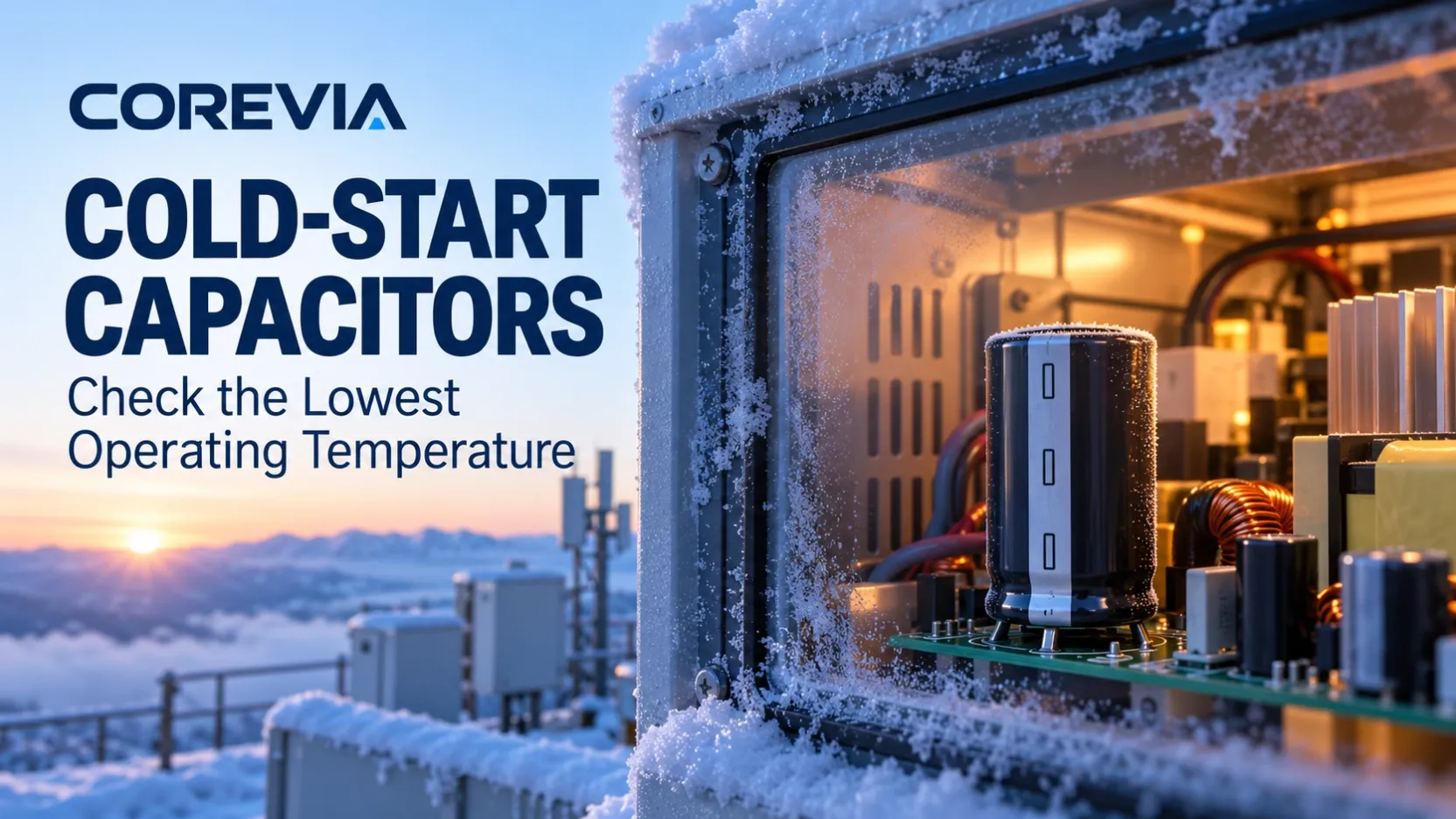
For a cold-start power supply, check the minimum operating temperature at the exact capacitor series and voltage rating—not just the temperature printed in a portfolio overview. In COREVIA's snap-in range, the lower temperature limit can change within one series as rated voltage changes. A design that starts normally in a warm lab still needs validation after the complete assembly has stabilized at its lowest expected temperature.
The customer question is practical: which capacitor information should you request before approving an outdoor supply that must start after a cold night?
1. Why can the same power supply behave differently when cold?
As an aluminum electrolytic capacitor gets colder, its capacitance and impedance can change. Increased impedance can affect filtering and the current a circuit can draw during start-up. The result depends on the exact part, frequency, circuit, load and temperature. A room-temperature capacitance reading alone therefore cannot establish cold-start performance.
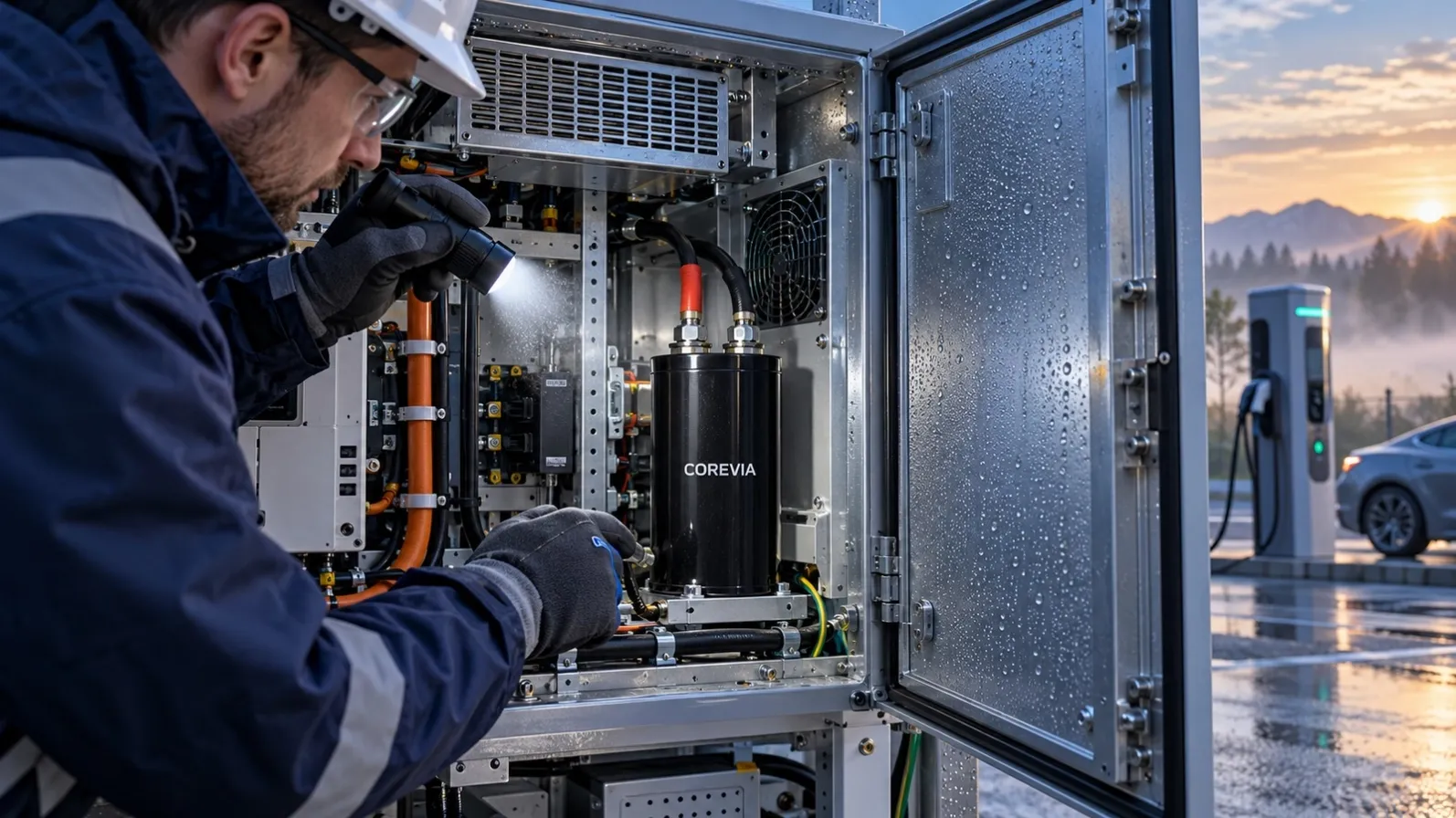
Start by recording the temperature at the capacitor body before energizing the equipment. An outdoor ambient specification is not necessarily the same as the temperature inside a cabinet; after power-up, internal heating can change conditions again. The cold-soak test must represent the period when the power supply is actually asked to start.
2. Check the voltage-specific limit in the COREVIA series
COREVIA's snap-in capacitor family page lists several series and their voltage-dependent operating temperature ranges. These published family examples show why the voltage rating must be read together with the minimum temperature:
| COREVIA series | Rated-voltage range shown on the family page | Published operating-temperature range |
|---|---|---|
| SP | 10–400 V DC | −40 to +85 °C |
| SP | 420–500 V DC | −25 to +85 °C |
| SH | 16–100 V DC | −40 to +105 °C |
| SH | 160–550 V DC | −25 to +105 °C |
These ranges describe the series groups shown on the site. They do not mean that every capacitance, dimension or exact part number is offered at every voltage. They also do not guarantee that a complete power supply will start at the lower category limit. Request the exact COREVIA part specification and confirm its low-temperature impedance conditions for your operating frequency.
3. Build a cold-start validation plan around the actual circuit
Agree the pass criteria before testing. A useful test records both the capacitor condition and the power-supply result, instead of treating the ambient chamber setting as the only evidence.
| Check | Record for the cold-start review |
|---|---|
| Minimum temperature | Required ambient range and measured capacitor-body temperature at start |
| Exact part | COREVIA series, full part number, rated voltage, capacitance and case size |
| Electrical behavior | Bus or output voltage during start, start-up time and any protection trip |
| Load and frequency | Load profile and the relevant ripple or switching-frequency conditions |
| Repeatability | Cold-soak duration, number of starts, and results after returning to normal temperature |
For an enclosed unit, include the intended enclosure, wiring and load in the test. If the system fails to start, inspect the complete start-up path and protection sequence; do not assign the cause to the capacitor solely from a warm-versus-cold comparison. Document any part substitution against both its electrical and mechanical requirements.
4. Frequently asked questions
Does a −40 °C lower operating limit guarantee my supply will start at −40 °C?
No. It identifies a specified temperature boundary for a particular series and voltage group. Start-up is a system result and must be tested with the exact part, circuit and load.
Can I choose a capacitor using only its 105 °C upper rating?
No. Check the lower limit for the proposed voltage as well. The SP and SH examples above show that a series may have different lower limits across voltage groups.
Is a room-temperature LCR measurement enough for cold-start approval?
No. It does not show the part's electrical behavior at the lowest operating temperature or prove that the full supply starts under load.
What should I send to COREVIA for selection support?
Send the lowest expected capacitor-body temperature, rated voltage, capacitance, ripple current and frequency, case dimensions, load profile, start-up requirement and expected quantity. Contact COREVIA for an exact-part review, then validate the proposed part in the finished equipment.