Sep 14, 2026Reliability Engineering
Why Does an Aluminum Electrolytic Capacitor Bulge on One Side?
A practical failure-analysis guide to separating internal-pressure effects from mechanical deformation when a capacitor bulges on only one side.
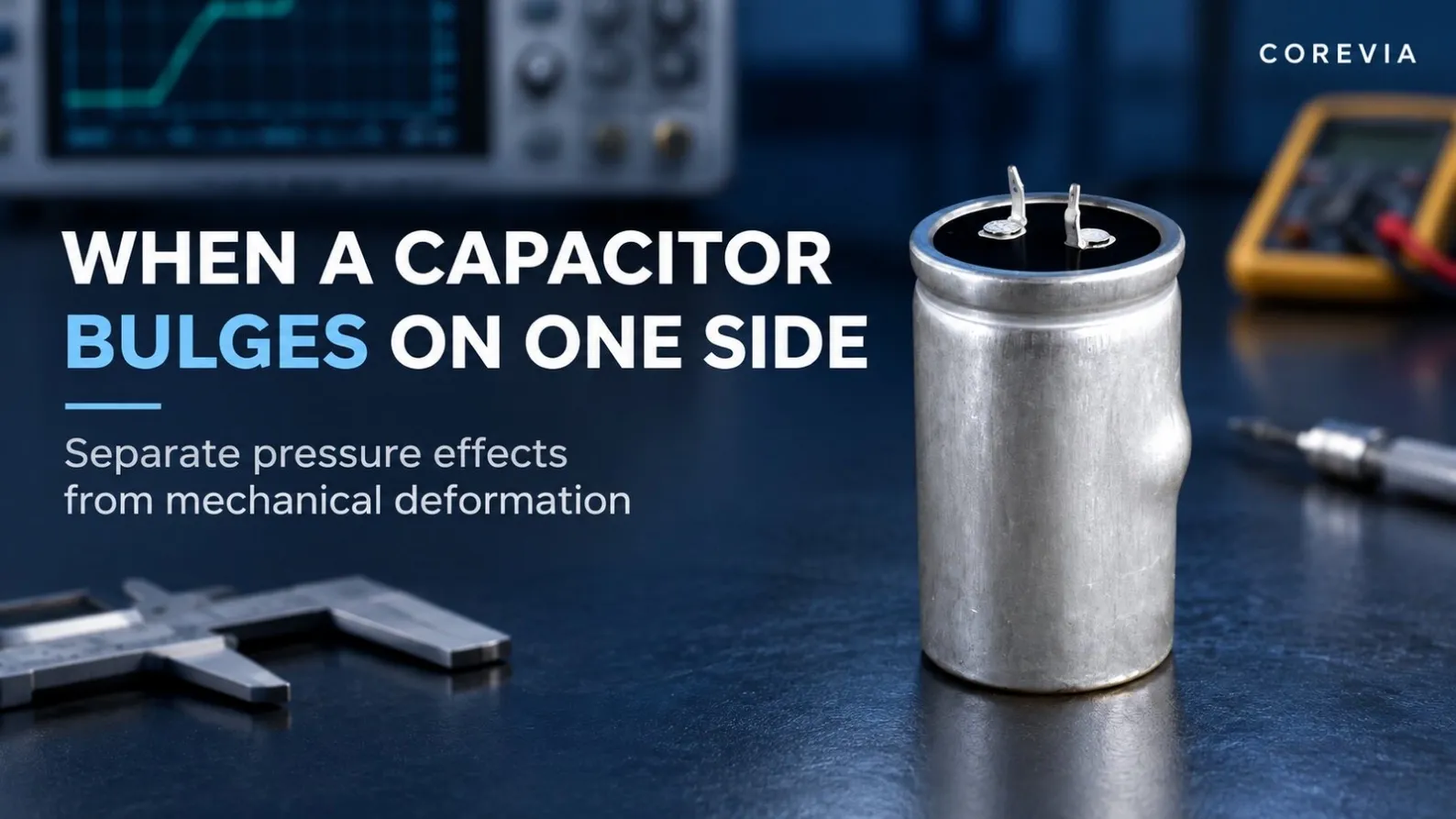
A bulged capacitor is often associated with excessive internal pressure. However, the location and shape of the deformation matter.
In this case, the aluminum can is not evenly swollen. One side has a clear local bulge while the opposite side remains comparatively straight. This pattern should not immediately be described as overvoltage or excessive internal pressure.
Why the Shape Matters
Gas pressure inside a sealed capacitor acts in multiple directions. When pressure is the main factor, engineers normally look for related evidence around the pressure-relief vent, seal and overall can geometry.
A single localized bulge suggests that the force may not have been evenly distributed. Mechanical stress, internal misalignment or a locally weakened section of the aluminum case should therefore be investigated.
Possible Causes
- Installation or clamp pressure
An overtightened clamp or uneven supporting surface can concentrate force on one section of the case. The deformation may become visible immediately or develop after vibration and temperature cycling.
- Handling or transportation damage
A drop, impact or heavy object pressing against the capacitor can permanently deform the thin aluminum case. Packaging should also be checked for compression or collision marks.
- Internal winding displacement
If the internal winding is not correctly centered, or if it moves after impact, it may press against one side of the case. This can produce a localized outward deformation.
- Local weakness in the aluminum case
Uneven wall thickness, a forming irregularity or prior mechanical damage can create a weak area. If internal pressure later increases, that section may deform before the rest of the case.
- Electrical or thermal stress
Overvoltage, reverse polarity, excessive ripple current and high operating temperature can increase internal heating and gas generation. These conditions remain important, but the electrical data must support the conclusion.
How to Investigate the Failure
First, confirm whether the deformation was present before the sleeve was removed. Then compare the capacitor with an unused unit of the same model.
Inspect the mounting clamp, surrounding structure and packaging for signs of concentrated force or impact. Check the pressure-relief vent, seal and case for leakage, discoloration or corrosion.
Review the actual operating voltage, polarity, ripple-current conditions, case temperature and cooling environment. Capacitance, ESR and leakage current should also be evaluated using the manufacturer's recommended test method.
If the cause remains unclear, a controlled teardown can check the position and roundness of the winding, its clearance from the case and the condition of the aluminum wall.
The Practical Conclusion
A localized side bulge is a symptom, not a complete diagnosis.
Based on appearance alone, mechanical stress or internal misalignment deserves priority attention. Internal pressure should still be checked, but it should not be assumed without supporting evidence.
Good failure analysis separates what we can see from what we can prove.
COREVIA | Aluminum Electrolytic Capacitor Solutions