Sep 26, 2026Reliability Engineering
Why Screw-Terminal Capacitor Connections Become Hot Spots
A practical guide to finding local heating at screw-terminal capacitor connections, including torque, busbar contact, vibration and thermal inspection.
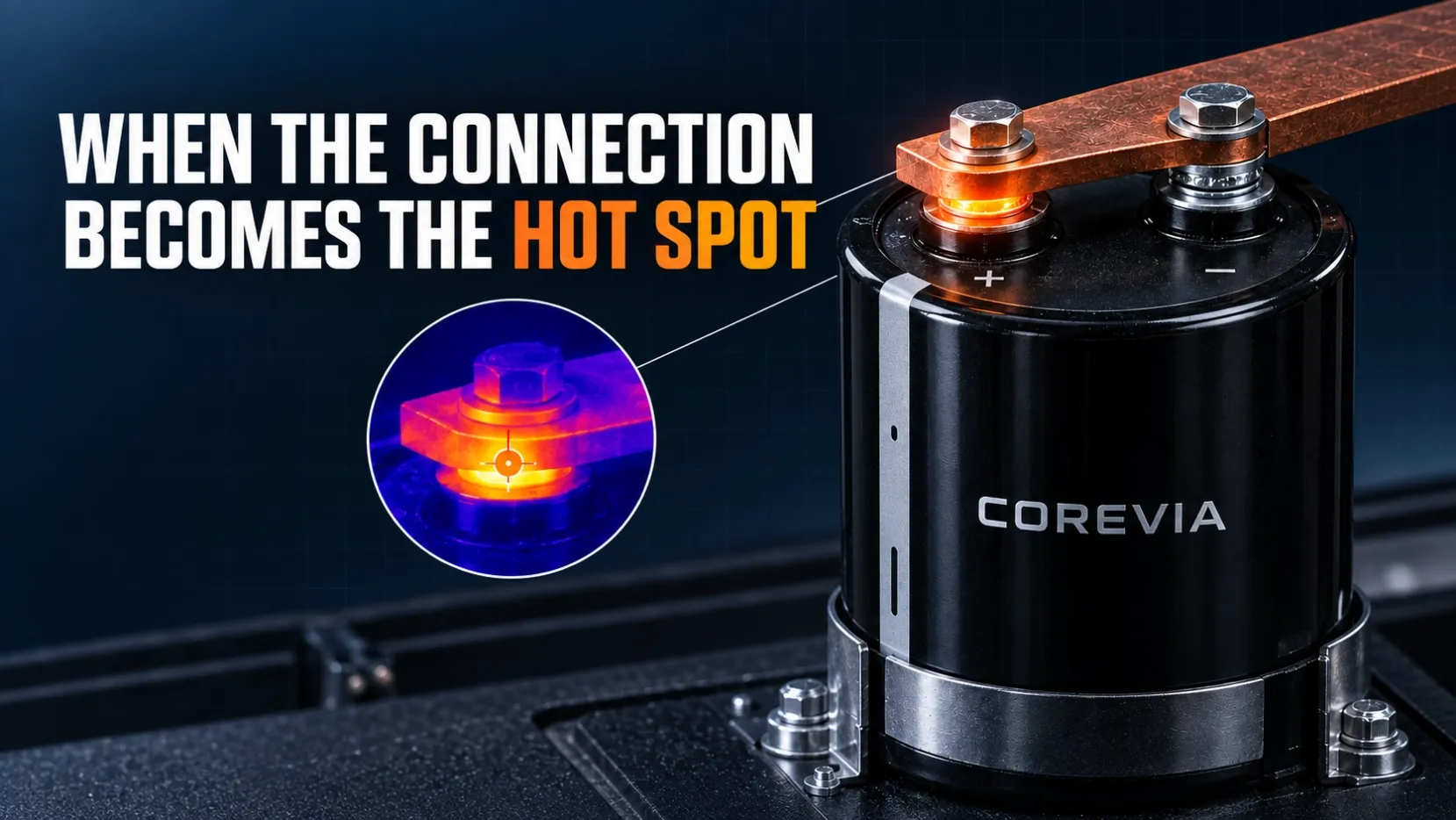
A capacitor can be correctly selected and still run hot because of the connection around it.
This is easy to miss in UPS systems, inverters, industrial drives and energy-storage converters. The voltage and capacitance may be correct, the ripple-current rating may be adequate, and the capacitor body may look normal. Yet a thermal inspection shows one terminal running noticeably hotter than the others.
In that situation, the capacitor should not be judged in isolation. The screw terminal, fastener and busbar form part of the same electrical and thermal path.
WHY THE TERMINAL AREA HEATS UP
Every mechanical electrical joint has some contact resistance. When the surfaces are clean, flat and tightened correctly, that resistance remains low. If the contact becomes loose or uneven, even a small increase in resistance can create significant local heating under high current.
The heat may be concentrated around the terminal rather than inside the capacitor winding. Over time, repeated heating and cooling can make the joint less stable and accelerate deterioration around the connection.
COMMON CAUSES FOUND IN THE FIELD
- Incorrect tightening torque
Too little torque may leave an unstable contact. Excessive torque is not a safe correction because screw terminals and mounting hardware have mechanical limits. The correct value must come from the datasheet for the exact capacitor series and terminal size.
- Poor busbar contact
A busbar that is bent, twisted or not sitting flat can reduce the real contact area. A joint may look tight from above while only part of the surface is carrying current.
- Contamination or oxidation
Oil, dust, residue or oxidized contact surfaces can increase resistance at the interface. Contact areas should be clean and prepared according to the equipment and component manufacturer's instructions.
- Incorrect or damaged hardware
Washers, bolts and other mounting parts should match the intended assembly. Damaged threads, reused hardware or parts with lower torque limits can make the connection unreliable.
- Vibration and mechanical stress
Industrial equipment is often exposed to vibration. The busbar should not pull sideways on the capacitor terminal or use the terminal as a mechanical support. Movement and repeated stress can gradually weaken the joint.
- Unequal current sharing
In a parallel capacitor bank, differences in busbar geometry and connection impedance can cause one unit to carry more current than expected. A hot terminal may therefore indicate both a connection issue and an uneven current path.
A PRACTICAL INSPECTION SEQUENCE
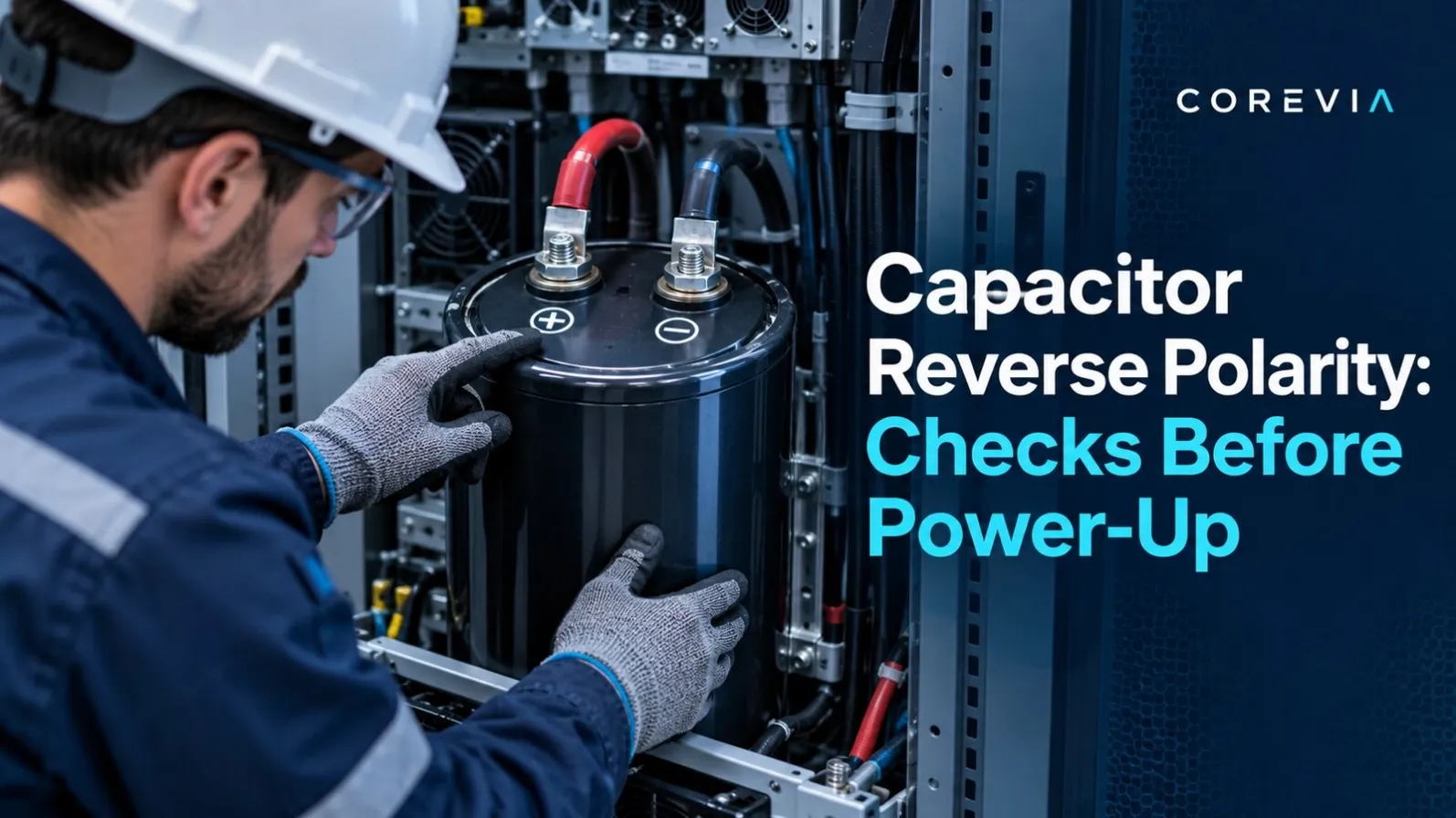
• Switch off the equipment and discharge the capacitors safely before touching the assembly.
• Compare all terminals for discoloration, looseness, contamination and uneven contact.
• Check the tightening requirement for the exact capacitor series. Do not use one universal torque value for every product.
• Confirm that the busbar sits flat and does not apply lateral force to the terminal.
• Inspect washers, bolts, threads and other hardware for damage.
• Run a thermal scan under a stable, representative load and compare corresponding terminals.
• If one unit remains hotter, review current sharing, ripple current, cooling and the capacitor's electrical condition.
WHAT THE TEMPERATURE PATTERN CAN TELL YOU
If the hottest point is concentrated at the terminal-to-busbar interface, the connection deserves immediate attention. If the entire capacitor body is heating, the investigation should also include ripple current, ESR, ambient temperature and airflow.
When only one capacitor in a bank shows a hot terminal, compare it with the neighboring units under the same load. That comparison is often more useful than looking at a single temperature value without context.
ENGINEERING TAKEAWAY
Not every hot capacitor has an internal capacitor problem. Sometimes the connection is the hot spot.
Good capacitor selection still needs good installation. Correct terminal torque, full busbar contact, clean surfaces and controlled mechanical stress all contribute to reliable operation.
COREVIA supports aluminum electrolytic capacitor selection and application review for UPS systems, inverters, industrial drives, energy storage and other power-electronics equipment. For a technical review, send us the original capacitor model together with the operating voltage, ripple-current conditions, ambient temperature and installation photos.